

Enterprise-wide intelligent business transformation programmes fail to deliver ROI in the majority of cases because they optimise for scope over outcomes. Smaller, outcome-defined programmes consistently outperform them and the evidence is hard to ignore.
Why Large Transformation Programmes Fail to Deliver Shareholder Value
If your board has approved a large-scale transformation programme in the last three years, there is a statistically significant chance it is destroying value right now, quietly, gradually, and with a full project management office tracking the decline in weekly status reports.
This is not cynicism. It is pattern recognition.
Research consistently shows that 70–75% of large transformation programmes fail to meet their original objectives. More damaging than outright failure, however, is the slow burn: programmes that technically “complete” but deliver a fraction of the promised value, two years late, at double the original budget.
Boards keep approving them anyway. The question worth asking in every boardroom is: why?
The Structural Problem With Enterprise-Wide Change Agendas
Large transformation programmes carry an inherent design flaw. They are built around scope, the breadth of what will change rather than outcomes, the specific value that change is meant to generate.
This creates several compounding problems:
- Accountability diffusion : When everything is changing, no single owner is responsible for any specific result
- Horizon drag : Multi-year timelines mean market conditions, leadership, and strategic priorities shift before the programme delivers anything
- Complexity inflation : Each additional workstream adds integration risk exponentially, not linearly
- Measurement ambiguity : Broad change agendas make it easy to declare success without demonstrating shareholder value
The result is a programme architecture that is almost perfectly designed to spend capital without generating returns.
How to Identify Whether Your Transformation Programme Is Destroying Value
Ask your programme leadership these three questions:
- What specific, measurable business outcome will be achieved in the next 90 days and what is the financial value of that outcome?
- If we stopped this programme today, which business outcomes would we definitively not achieve?
- What is the cost-per-outcome-delivered so far, and how does that compare to the original business case?
If these questions produce vague answers, long pauses, or references to “programme milestones” rather than business results, you are funding activity, not transformation.
The Case for Smaller, Outcome-Defined Programmes
The alternative is not timidity. It is precision.
Intelligent business transformation starts with a different design question. Not “what needs to change across the enterprise?” but “what is the single highest-value outcome we can achieve in the shortest defensible timeframe and what is the minimum change required to achieve it?”
This approach consistently delivers better results because:
- It forces specificity : You cannot hide behind programme complexity when the mandate is a defined outcome
- It accelerates value realisation : Shorter cycles mean faster returns and faster reinvestment
- It reduces risk exposure : Smaller scope means fewer integration dependencies and lower failure surface area
- It builds organisational confidence : Delivered outcomes fund the next initiative; failed programmes fund nothing
Outcome-defined transformation also provides boards with something large programmes rarely offer: a clear, defensible link between capital allocation and shareholder value creation.
What Intelligent Business Transformation Actually Looks Like in Practice
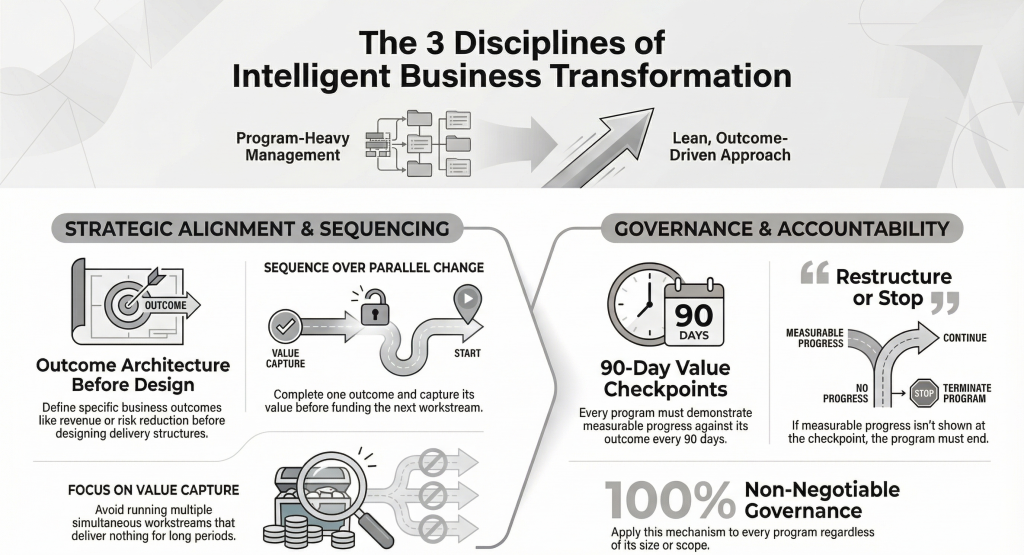
For decision-makers evaluating how to restructure their approach to change, the practical shift involves three disciplines:
1. Outcome architecture before programme design Define the specific business outcome, revenue growth, cost reduction, customer retention improvement, risk reduction , before designing any delivery structure. The programme exists to serve the outcome, not the other way around.
2. 90-day value checkpoints as a non-negotiable governance mechanism Every programme, regardless of size, should be able to demonstrate measurable progress against its business outcome every 90 days. If it cannot, it should be restructured or stopped.
3. Portfolio sequencing over parallel enterprise change Rather than running five transformation workstreams simultaneously and delivering nothing for 18 months, sequence them. Complete one outcome. Capture the value. Fund the next.
The Board’s Role in Reversing the Pattern
The approval problem is partly structural. Large transformation programmes are presented with compelling business cases, strong external validation, and the implicit message that the risk of not transforming is greater than the risk of the programme itself.
Boards can change this dynamic by demanding:
- Outcome-first programme design : No approval without a clearly defined, measurable business outcome as the primary success criterion
- Stage-gated capital release : Fund 90-day cycles, not multi-year programmes in full
- Independent outcome verification : Separate from the programme team delivering the work
Frequently Asked Questions
Q: How do outcome-defined transformation programmes differ from traditional change management?
A. Traditional change management focuses on managing the people and process side of large-scale change. Outcome-defined transformation starts with a specific business result and works backwards to the minimum change required to achieve.
Q: What is the typical ROI timeline for a smaller, outcome-defined transformation programme?
Well-structured outcome-defined programmes typically demonstrate measurable financial returns within 90 to 180 days of initiation, compared to 18 to 36 months for large enterprise programmes.
Q: How do we migrate from a large existing transformation programme to an outcome-defined approach?
The most effective method is a structured programme audit: map every active workstream to a specific business outcome, quantify the value of each, and restructure or stop workstreams that cannot demonstrate a clear outcome link within the next 90 days.
200OK Solutions delivers intelligent business transformation for organisations that need outcomes, not programmes. Learn more at 200oksolutions.com
You may also like: Why We Switched from Hotjar to Microsoft Clarity