

Most retail loyalty programmes are structured around discounts and points that erode margin without meaningfully increasing customer lifetime value (CLV). The fix isn’t scrapping your programme, it’s restructuring it around behavioural economics, data intelligence, and outcome-based rewards that drive profitable retention, not just repeat visits.
The Loyalty Programme Paradox Dominating Retail News
Every week, publications from Retail Gazette UK to Retail Week run headlines about the next big loyalty launch. Retailers collectively spend billions annually on these programmes. Yet a striking number quietly haemorrhage margin.
Customers redeem points on purchases they would have made anyway. Discounts train shoppers to wait for offers. And the “loyal” customers at the top of your tier system are often your least profitable because they’ve learned to game every reward mechanism you offer.
As widely covered across retail business media and retail bulletin commentary, the loyalty paradox is real: the more you invest in traditional programmes, the more margin you risk surrendering.
If your loyalty programme isn’t tied directly to customer lifetime value economics, it isn’t a retention strategy, it’s a recurring cost centre dressed up as one.
Why Traditional Loyalty Models Are Broken
The legacy model earn points, redeem discounts was built for a world without granular data. It treats all customers the same, rewarding frequency over profitability.
Analysts writing in Retail Times and Retail Week have noted a consistent pattern: retailers report strong enrolment numbers while quietly absorbing the margin impact beneath the surface.
Here’s what the traditional model actually costs you:
- Margin dilution: Blanket discounts reduce net revenue per transaction without guaranteeing incremental spend
- Reward redemption liability: Unspent points sit on your balance sheet as a financial obligation
- Low emotional engagement: Points feel transactional, not relational, they don’t build brand affinity
- Data waste: Most programmes collect enormous behavioural data but use less than 20% of it to personalise the experience
- Adverse selection: Your highest redeemers are often your lowest-margin customers
The result? A programme that looks successful on headline metrics but quietly destroys CLV economics at the unit level. This is exactly the kind of structural issue that retail news coverage tends to surface only after a brand has already taken the hit.
How to Diagnose Whether Your Loyalty Programme Is Net Positive
Before restructuring, decision-makers need honest answers to these questions:
- What is the incremental revenue per loyalty member, above what they would have spent without the programme?
- What is your cost-per-retained-customer through loyalty versus other channels?
- Are your highest-tier members your most profitable customers, or just your most frequent ones?
- How much of your rewards budget drives new behaviour versus rewarding existing behaviour?
- What is the redemption liability sitting on your balance sheet right now?
If you can’t answer these cleanly, your loyalty programme is operating on assumption, not intelligence.
What Intelligent Loyalty Looks Like: A Framework for Retail Leaders
Transforming loyalty into a CLV growth engine requires shifting from a transactional model to an intelligence-led one. Across grocery gazette and grocery news reporting, the grocers leading on retention, not just acquisition are the ones rebuilding their programmes around data, not discounts.
Here’s the framework retail and grocery leaders are applying:
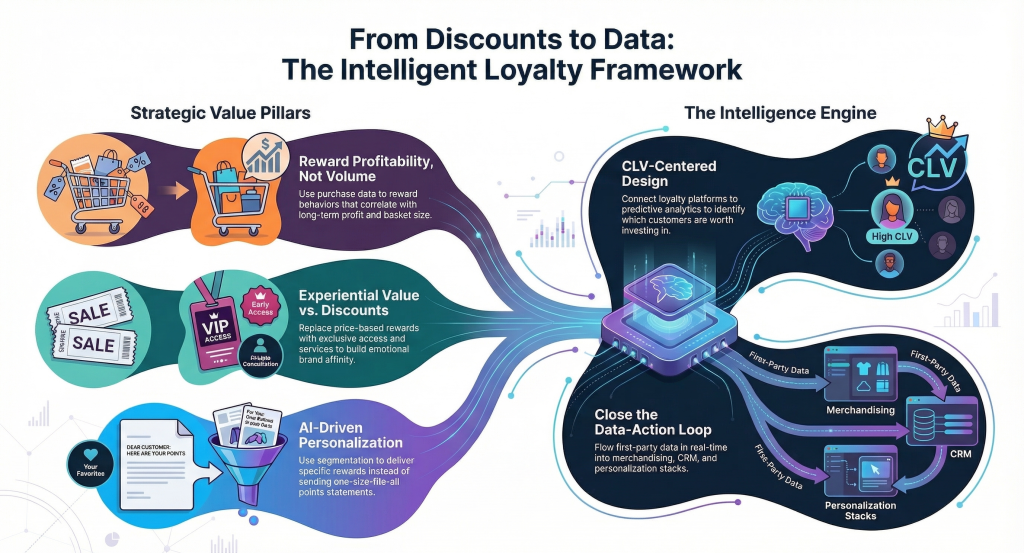
1. Shift Rewards from Volume to Value Behaviour
Stop rewarding every purchase equally. Use purchase data to identify which customer behaviours actually correlate with long-term profitability, cross-category buying, higher basket sizes, reduced return rates and weight your rewards accordingly.
2. Build Personalisation Into the Reward Architecture
Personalised offers consistently outperform blanket discounts on both redemption rates and margin contribution. Use AI-driven segmentation to deliver the right reward to the right customer at the right moment, not a one-size-fits-all points statement.
3. Replace Discount Dependency With Experiential Value
Price-based rewards commoditise your brand. Experiential rewards, early access, exclusive events, personalised services build emotional loyalty that discount-seekers can’t arbitrage. They cost less to deliver and generate stronger brand affinity.
4. Integrate CLV Modelling Into Programme Design
Every reward decision should be evaluated against its projected impact on customer lifetime value. This means connecting your loyalty platform to your CLV model and using predictive analytics to identify which customers are worth investing in and at what level.
5. Close the Loop Between Data and Action
Your loyalty programme is your single richest source of first-party customer data. If that data isn’t flowing in real time into your merchandising, CRM, and personalisation stack, you’re leaving the most valuable asset in your retail business idle.
The Business Case for Intelligent Loyalty Transformation
When loyalty programmes are rebuilt around CLV economics and intelligent personalisation, the outcomes shift dramatically:
- Reduced cost per retained customer as spend becomes more targeted
- Higher average order values from personalised cross-sell and upsell triggers
- Improved margin per transaction as discount dependency falls
- Stronger first-party data assets ahead of cookie deprecation
- Measurable incremental revenue rather than vanity metrics
This is the difference between a loyalty programme that reports activity and one that drives outcomes, the standard every serious retailer should be holding their programme to.
Frequently Asked Questions
Q. How do I calculate whether my retail loyalty programme is profitable?
A. Compare the incremental revenue generated by loyalty members, spend above baseline behaviour against the total cost of the programme, including rewards liability, platform costs, operational overhead, and marketing spend. If incremental revenue doesn’t exceed total cost, the programme is margin-negative.
Q. How long does it take to restructure a retail loyalty programme?
A. A phased intelligent transformation typically runs across three horizons: diagnostic and data audit (4–8 weeks), programme redesign and personalisation layer build (3–6 months), and full CLV-integrated deployment (6–12 months). Quick wins in segmentation and offer personalisation are often visible within the first 90 days.
Q. What technology is needed to build an intelligent loyalty programme for retail?
A. Core requirements include a unified customer data platform (CDP), AI-driven segmentation and predictive CLV modelling, real-time personalisation capability, and loyalty platform APIs that connect rewards logic to your broader commerce stack. Legacy point solutions rarely support this without integration or replacement.
Q. Why are grocery loyalty programmes under pressure right now?
A. As covered extensively in grocery gazette and grocery news, grocery loyalty schemes face a dual squeeze: rising cost-of-living pressure has made customers more transactional, while own-label growth means the margin available to fund rewards is thinning. Grocers that restructure around CLV and behavioural data are outperforming those running legacy points mechanics.
Q. The Path Forward for Retail Decision-Makers
A. Loyalty programmes don’t fail because customers don’t want to be loyal. They fail because the economics were never properly designed.
Whether you’re a national retailer managing a multi-tier programme or a regional grocery operator watching margin pressure mount, the challenge is the same: turning loyalty spend into a measurable business outcome rather than a sunk cost.
At 200OK Solutions, our intelligent business transformation practice works with retail and grocery leaders to rebuild loyalty economics from the ground up, connecting customer data, CLV modelling, and personalisation infrastructure into programmes that generate measurable results.
If your loyalty programme is costing more than it earns, the answer isn’t to spend more on it. It’s to make it smarter.
Ready to rethink your loyalty economics? Talk to our team at 200OK Solutions