

If your organisation is losing revenue to slow decisions, manual processes, or disconnected data, you’re already paying the cost of not transforming. This guide shows decision-makers exactly how to assess transformation readiness and what to do first.
The Question Most Leaders Ask Too Late
Most CEOs and COOs don’t ask “are we ready for intelligent business transformation?” until they’re already behind. A competitor has automated what your team still does manually. A market shift exposed how long your decision cycle actually takes. A client churned because your systems couldn’t respond fast enough.
Readiness assessment isn’t a preliminary step. It’s a revenue protection exercise.
What “Ready” Actually Means
Readiness for intelligent business transformation doesn’t mean having perfect data, a fully modernised tech stack, or a dedicated AI team. Organisations that wait for perfect conditions never transform.
Readiness means three things:
- Clear outcome ownership : a CTO, COO, or CEO who is accountable for transformation results, not just transformation activity
- Defined business problems : specific revenue or efficiency gaps that transformation is expected to close
- Willingness to measure : a commitment to establishing baselines before implementation begins
If those three conditions exist, transformation can begin productively regardless of your current technology maturity.
7 Signs Your Business Is Ready And Leaving Revenue on the Table
1. Your reporting is always historical, never predictive
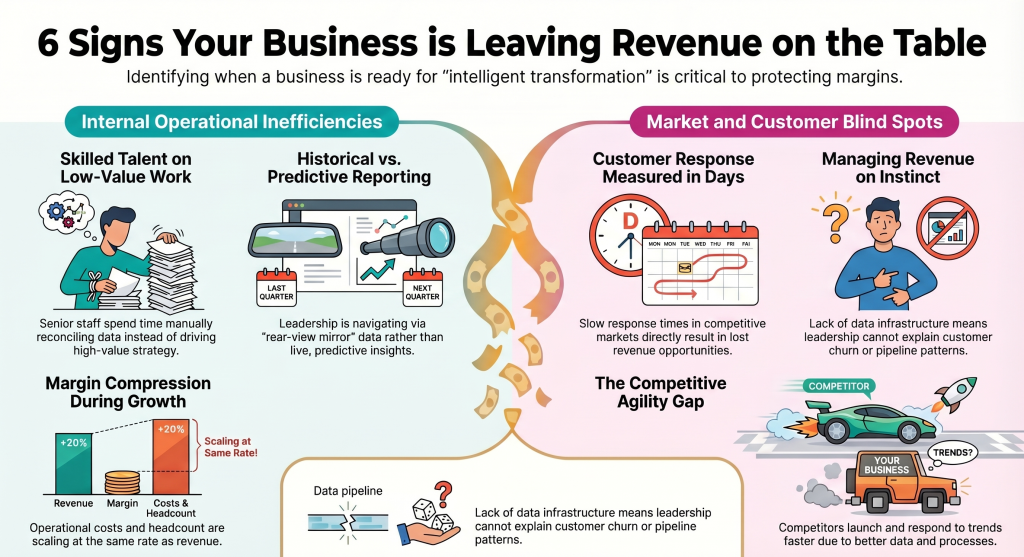
If leadership is making decisions based on last month’s data, you’re navigating with a rear-view mirror. Intelligent transformation replaces static reporting with live, predictive insight, so decisions are made on what’s happening now, not what happened before.
2. Your best people spend time on low-value work
When senior analysts are manually compiling spreadsheets, when operations managers are chasing approvals, when finance teams are reconciling data across disconnected systems, your organisation is funding inefficiency with skilled labour. That’s a margin problem disguised as a workflow problem.
3. Customer response times are measured in days, not minutes
In markets where experience is a differentiator, slow response is lost revenue. If your teams can’t personalise, escalate, or resolve without manual intervention, intelligent transformation directly addresses that gap.
4. You can’t answer “why did we lose that client?”
If your organisation lacks the data infrastructure to understand customer behaviour, churn signals, or pipeline conversion patterns, you’re managing revenue on instinct. That’s a solvable problem, and solving it has direct digital transformation revenue impact.
5. Every new initiative requires a new system
Organisations without intelligent infrastructure bolt on new tools for every new need. The result is a fragmented landscape that slows decision-making and increases risk. Transformation readiness includes a willingness to consolidate around outcomes rather than accumulate tools.
6. Your competitors are moving faster than you can explain
If a competitor has launched a product, entered a market, or responded to a trend before you even identified it, the gap is usually data and process, not strategy. Business agility and outcomes are inseparable; if agility is low, outcomes will follow.
7. You’re growing but margins are compressing
Revenue growth with shrinking margins is one of the clearest signals that operational infrastructure hasn’t scaled with commercial activity. Intelligent transformation scales operations without scaling headcount proportionally.
How to Assess Your Readiness in 30 Days
A structured readiness assessment doesn’t require months of consultancy. Here’s how to approach it as a leadership team:
Week 1 : Map the Revenue Leaks
Identify the top five processes that directly touch revenue generation, customer retention, or operational cost. Document the current cycle time, error rate, and manual touchpoints for each.
Week 2 : Audit Your Data Landscape
Determine where your critical business data lives, how often it’s updated, and who can access it for decisions. If the answer involves email chains and shared drives, you have a data readiness gap that must be addressed before AI can add value.
Week 3 : Define the Outcome, Not the Technology
Resist the urge to identify tools at this stage. Instead, complete this sentence for each problem area: “If we solve this, we expect to see [specific metric] improve by [target] within [timeframe].” This becomes your transformation ROI framework.
Week 4 : Identify Your Constraints
Budget, internal capability, and change tolerance are real variables. Understanding them early shapes whether you begin with a targeted pilot or a broader programme, and prevents transformation initiatives from stalling mid-execution.
The Cost of Waiting
One of the most important inputs for any decision-maker evaluating transformation is the cost of inaction.
Every quarter spent with manual processes, disconnected data, and slow decision cycles has a revenue value. Transformation consulting in London and across the UK consistently shows that organisations who delayed readiness assessment by 12 months faced higher implementation costs and larger competitive gaps than those who began early.
Readiness doesn’t get easier with time. Competitive pressure doesn’t pause while you prepare.
Frequently Asked Questions
Q. How do I know if my business data is good enough to start intelligent transformation?
A. Perfect data is not a prerequisite. Start with the data you have, identify its gaps during assessment, and build data quality improvement into the transformation roadmap rather than treating it as a blocker.
Q. What size business benefits most from intelligent business transformation?
Organisations with 50+ employees and defined operational processes typically see the clearest ROI. However, the principles apply at any scale, the readiness criteria remain the same.
Q. How much does a transformation readiness assessment cost?
A focused readiness assessment with a specialist partner typically takes four to six weeks. At 200OK Solutions, we structure initial assessments around your specific business outcomes so you know exactly what transformation will deliver before committing to a full programme.
Your Next Step Costs Nothing But Clarity
Intelligent business transformation isn’t a leap into the unknown. It’s a structured move from where your revenue is today to where it could be with the right infrastructure behind your decisions.
The readiness assessment is where that move begins. Talk to the team at 200OK Solutions and find out exactly where your organisation stands, and what it’s worth to change it.
You may also like : Smaller Programmes, Better ROI: The Case for Change