

In 2026, retail margin protection is no longer a pricing challenge, it is a data architecture challenge. The retailers that are winning are those that sense demand shifts in real time and act within hours, not weeks.
Why Retail Margin Protection in 2026 Is a Data Problem
Retail leaders protecting margins today are not relying on deeper discounting or blanket cost-cutting. Instead, they are transforming how fast their organisations sense demand shifts and respond to them. Specifically, the retailers winning right now combine real-time inventory intelligence, multi-channel demand-signal integration, and the operational agility to reprice, reroute, and reprioritise SKUs within hours.
Furthermore, if your business still runs weekly demand reviews on month-old ERP data, you are making 2026 retail margin decisions with a blindfold on. The gap between sensing and acting is where margin dies.
What the 2026 Numbers Are Actually Telling Retail Leaders
The margin pressure retailers are navigating in 2026 did not arrive suddenly. It has been building through compounding structural shifts and the data makes clear this is not a cycle that corrects itself without deliberate operational change.
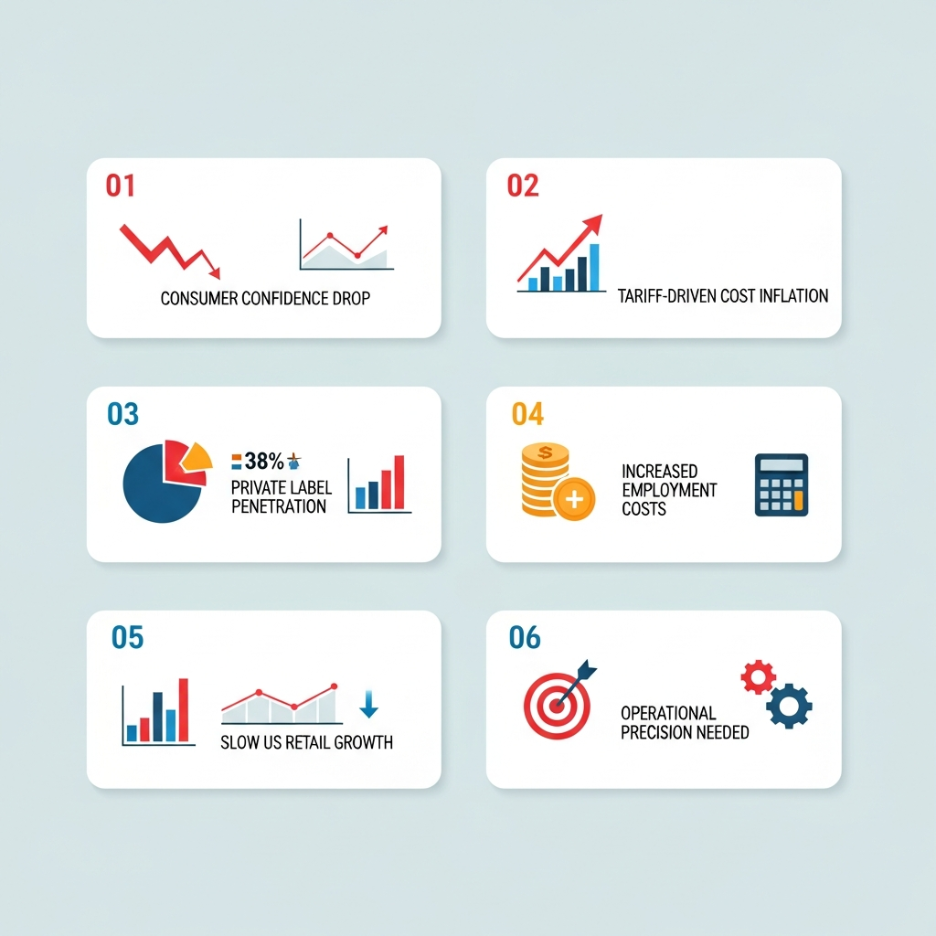
- Consumer confidence in major markets entered 2026 at its lowest point since 2011, with the UK GfK index hitting -22 in January 2026 and US Conference Board confidence falling to 98.3, a level last seen during the early stages of post-pandemic uncertainty
- Tariff-driven cost inflation locked in through 2025 is still working through retail supply chains in 2026, with effective import tariff rates sitting at an 18-year high after jumping from 2.4% to 18.3% in a single year
- Private label penetration in European food retail crossed 38% and is still rising, compressing the viable margin band for branded mid-range SKUs
- UK retailers absorbed a combined £5 billion in new employment cost obligations from April 2026, the result of simultaneous increases in National Living Wage, employer National Insurance contributions, and business rates
- US retail growth is forecast at 2.7–3.7% for 2026, the slowest rate in five years, while operating cost structures have not compressed proportionately
The result is a margin environment where volume growth alone cannot rescue profitability. The only path is operational precision.
Three Retail Forces Making 2026 Different From Previous Downturns
Retail consumers have permanently re-anchored their price expectations
The K-shaped spending pattern that emerged in 2024 has hardened significantly in 2026. Premium and ultra-value segments are both growing, while the middle market hollows out. Notably, roughly 40% of US consumers now identify as deal-driven or cost-conscious in a way that persists even as inflation moderates. The price levels of 2022–2024 have permanently reset their reference points. Consequently, retailers built for the middle are caught between Aldi’s operational efficiency and the experience premium of true luxury, with no natural home.
The retail supply chain cost base is sticky in both directions
Retailers that diversified sourcing ahead of 2025 tariff escalation locked in cost advantages that their slower peers cannot close quickly. Those that did not are now operating with a structural cost disadvantage that repricing alone cannot fix. In other words, the supply chain decisions made in 2023 and 2024 are the margin outcomes retailers are reporting today.
The cost of operational inaction has compounded
Every week a retailer operates without integrated demand-to-margin visibility adds another week of suboptimal promotional spend, inflated inventory holding costs, and pricing decisions built on incomplete data. In a 3% growth environment with 10%+ cost inflation on labour, the margin math on operational inaction is unforgiving.
What Retail-Resilient Leaders Are Actually Doing in 2026
They replaced the weekly retail S&OP cycle with continuous demand intelligence
Retailers reporting margin stability in early 2026 operate demand-sensing platforms that pull POS data, returns signals, web traffic, and competitor pricing into a single near-real-time view. As a practical result, promotional decisions and replenishment calls happen within 24–48 hours, not after the next planning cycle. Moreover, in a retail market where a competitor price move or a social trend can shift category demand within a news cycle, the weekly review cadence is not merely a process inefficiency. It is a margin liability.
The retailers winning right now compress the time between a market signal and an operational response from weeks to hours.
They manage retail margin by SKU, not by category
Blanket promotional strategies, percentage-off across a category, uniform free-shipping thresholds, are giving way to SKU-level retail margin management. Retailers with integrated BI platforms can identify in real time which products are genuine margin contributors, which are footfall or basket drivers worth subsidising, and which are cash traps consuming working capital with no strategic justification. Therefore, the 67% of retailers who planned to shift their product mix toward higher-margin items in 2026 are finding that those doing it effectively have the data infrastructure to act with precision, not just the intention.
They built supplier intelligence, not just supplier relationships
The retailers that absorbed 2025 tariff shocks most effectively had already pre-mapped their tier-2 and tier-3 supplier dependencies, and had activated alternative sourcing agreements before the tariff orders landed. In 2026, this is now a data and platform capability, not merely a procurement competency. Similarly, knowing your retail supply chain exposure in real time, and modelling the margin impact of a sourcing disruption before it materialises, is now a board-level technology investment.
They closed the gap between operational data and financial outcomes
The most value-destructive pattern in retail right now is the lag between what the business does operationally and when the margin impact shows up in financial reporting. Retailers that have integrated their ERP, WMS, CRM, and POS data into a unified analytics layer can see the P&L impact of inventory, pricing, and promotional decisions as they happen, not three weeks later at month-end close. In 2026, this is not a competitive advantage. It is the baseline requirement for running a retail business responsibly.
The Retail Transformation Question Leaders Must Answer in 2026
The retailers that will report margin resilience at the end of 2026 will not be those that found a clever pricing strategy or a new supplier region. Instead, they will be those that used the pressure of this retail environment to build the operational and data architecture that should have been built years ago.
- How many systems does your team access to understand gross margin on a single retail SKU today?
- When a demand signal shifts, does your retail business respond in hours or weeks?
- Do your commercial, supply chain, and finance teams work from one version of demand truth, or from three different spreadsheets reconciled the night before a trading review?
- Is your retail technology architecture built to sense and respond, or simply to record and report?
Ultimately, the margin gap in retail in 2026 is not a strategy gap. It is a data and operational integration gap, and that is a solvable problem, but only for organisations that decide to treat it as one.

Frequently Asked Questions About Retail Margin Protection in 2026
How can retailers protect profit margins during demand volatility in 2026?
Retailers protecting margins in 2026 invest in near-real-time demand sensing, SKU-level dynamic margin management, ML-driven inventory optimisation, and integrated operational-financial platforms. The common thread is compressing the time between a market signal and an operational response, from weeks to hours.
What is driving retail margin compression in 2026?
Four converging pressures drive retail margin compression in 2026: sticky supply chain cost inflation from 2025 tariff escalation, significant new employment cost obligations (£5 billion for UK retailers from April 2026 alone), slowing consumer spending growth, and structurally price-anchored consumers who are not reverting to pre-2022 spending behaviours.
What technology gives retailers the highest ROI for margin protection?
The highest-ROI retail investments are unified demand-sensing platforms integrating POS, e-commerce, and external signals in near-real time; ML-driven inventory optimisation reducing holding costs by 15–25% and stockout rates by up to 30%; and integrated operational-financial analytics connecting ERP, WMS, and CRM so margin impact is visible in real time.
How does intelligent business transformation address retail demand volatility?
Intelligent business transformation addresses retail demand volatility by redesigning the data flows, platform integrations, and decision architectures that determine how fast an organisation can act. It connects commercial, supply chain, and finance functions to a single real-time view of margin performance, replacing fragmented, lagged reporting with operational intelligence.
Ready to Close the Gap Between Your Retail Data and Your Decisions?
200OK Solutions helps retail organisations build the platforms, integrations, and operational intelligence capabilities that turn demand volatility from a margin threat into a structural advantage.
You may also like: From Integration Chaos to Platform Excellence: How the Six Pillars of Platform Engineering Transform Enterprise Integration Strategy