

Hospitality groups that centralise their back-office operations, finance, HR, scheduling, procurement, and data management, consistently outperform fragmented competitors on cost efficiency, staff retention, and revenue per available room. The reason is straightforward: centralisation eliminates duplication, creates real-time visibility across properties, and frees unit managers to focus on guest experience instead of administrative fire-fighting.
The Hidden Cost of Fragmented Operations in Hospitality Management
Most hospitality groups grow through acquisition or franchise expansion. Each new property brings its own systems, its own spreadsheets, its own version of the truth. Over time, this creates an operational debt that compounds quietly, until it doesn’t.
Consider what fragmented back-office operations actually cost a multi-site hospitality business:
- Duplicated HR and payroll processes across every property, with no shared visibility into headcount or labour cost as a percentage of revenue
- Inconsistent procurement different properties buying the same supplies at different prices from different vendors
- Delayed financial reporting unit managers emailing spreadsheets instead of dashboards surfacing live data
- Compliance risk especially critical as the government’s minimum wage uplifts continue to compress margins across the hospitality industry
The result is a business that reacts instead of plans. In a sector already under pressure from rising operational costs, reactive management is not a viable long-term strategy.
What “Centralised Back-Office Operations” Actually Means for Hospitality Groups
Centralisation does not mean stripping autonomy from property managers. It means building a shared operational backbone standardised systems, integrated data flows, and centralised expertise, that every property plugs into.
In practice, an intelligent business transformation for a hospitality group typically involves:
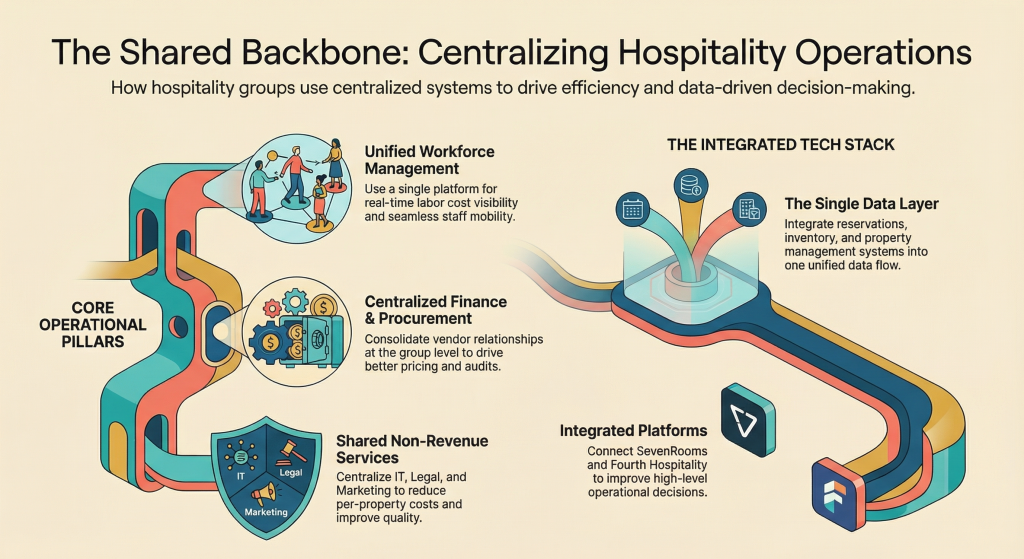
1. Unified HR and Workforce Management Replace property-level scheduling tools with a single platform. Staff can move between sites. Managers get visibility into labour cost in real time. Compliance with minimum wage legislation becomes a system function, not a manual check.
2. Centralised Finance and Procurement Group-level purchasing consolidates vendor relationships and drives better pricing. Finance operates from one version of the data. Month-end closes faster. Audit trails are clean.
3. Integrated Technology Stack Leading hospitality operators are increasingly integrating platforms like SevenRooms for reservations and guest experience, Fourth Hospitality for workforce and inventory management, and property management systems into a single data layer. When these systems talk to each other, operational decisions improve dramatically.
4. Shared Services for Non-Revenue Functions IT support, legal, compliance, and marketing functions operating as shared services reduce cost per property while improving quality and consistency.
How to Centralise Back-Office Operations Without Disrupting Property Performance
One of the most common questions from COOs and CTOs in multi-site hospitality groups is: how do we centralise back-office operations without disrupting day-to-day property performance?
Here is a practical phased approach:
- Audit current state : Map every back-office process at property level. Identify duplication, system gaps, and manual workarounds.
- Define the target operating model : What does the centralised function look like? Who owns what? Which decisions stay local?
- Standardise data before integrating systems : The most common failure in hospitality technology transformation is integrating systems before standardising data definitions. Fix this first.
- Pilot at two or three properties : Test the centralised model, measure the impact on unit managers’ time and on reporting quality, then roll out.
- Build change capability alongside the technology : Systems don’t transform businesses. People adopting new ways of working do.
The organisations that execute this well and the hospitality management literature consistently supports this reduce their cost-to-serve per property by 15–25% within 18 months of completing centralisation.
Operational Resilience Is the Real Competitive Differentiator
The hospitality industry conversation tends to focus on brand, loyalty programmes, and guest experience as competitive differentiators. These matter. But the groups that consistently outperform across economic cycles, rising input costs, labour market tightening, demand volatility are the ones with operational resilience built into their back office.
Operational resilience in hospitality means:
- The ability to flex staffing across properties : when demand shifts, without manual coordination
- Real-time financial visibility : that allows the group to act on margin pressure before it becomes a crisis
- Procurement agility : the ability to switch suppliers or renegotiate terms from a position of data, not guesswork
- Scalability : the ability to add a new property or brand without proportionally adding back-office headcount
Fragmented operations cannot deliver this. They are structurally incapable of it, no matter how talented the individual property managers are.
The Role of Intelligent Business Transformation
At 200OK Solutions, our intelligent business transformation practice works specifically with hospitality groups and multi-site operators to design and implement the centralised operating models that drive these outcomes.
We don’t sell technology. We redesign how your business operates and we make sure the technology serves that design, not the other way around.
The hospitality groups that will outperform over the next decade are already making this shift. The window to build this kind of operational advantage is now.
Frequently Asked Questions
Q. What back-office functions should hospitality groups centralise first?
A. Start with finance and HR, these deliver the fastest ROI and create the data foundation that makes everything else possible. Procurement centralisation typically follows, with IT and compliance functions rounding out the model.
Q. How long does it take to centralise back-office operations across a multi-site hospitality group?
A. A well-structured transformation programme typically takes 12–18 months from audit to full deployment across a portfolio of 5–20 properties. Larger portfolios with more legacy systems may take 24–36 months.
Q. Will centralising back-office operations reduce headcount at property level?
A. In most cases, yes, but the reduction is in administrative roles, not operational or guest-facing roles. Many organisations redeploy that capacity into revenue-generating activity rather than making redundancies.
Q. How does centralisation affect hospitality manager autonomy?
A. Effective centralisation preserves operational autonomy at property level while removing the administrative burden. Managers spend less time on reporting and compliance and more time on the guest experience and team performance.
Q. What technology platforms support centralised back-office operations in hospitality?
A. Leading platforms include Fourth Hospitality for workforce management, Oracle Hospitality for property management, and SevenRooms for guest experience. The right stack depends on your portfolio size, brand mix, and existing infrastructure.
Ready to build operational resilience into your hospitality group? Visit 200oksolutions.com to explore how our intelligent business transformation practice can help.
You may also like: From Occupancy to Operating Margin: Rebuilding the Hospitality P&L